
Niveau d'étude visé
Bac +5
ECTS
120 crédits
Durée
2 ans
Composante
UFR Physique, Ingénierie, Terre, Environnement, Mécanique (PhITEM)
Langue(s) d'enseignement
Anglais
Présentation
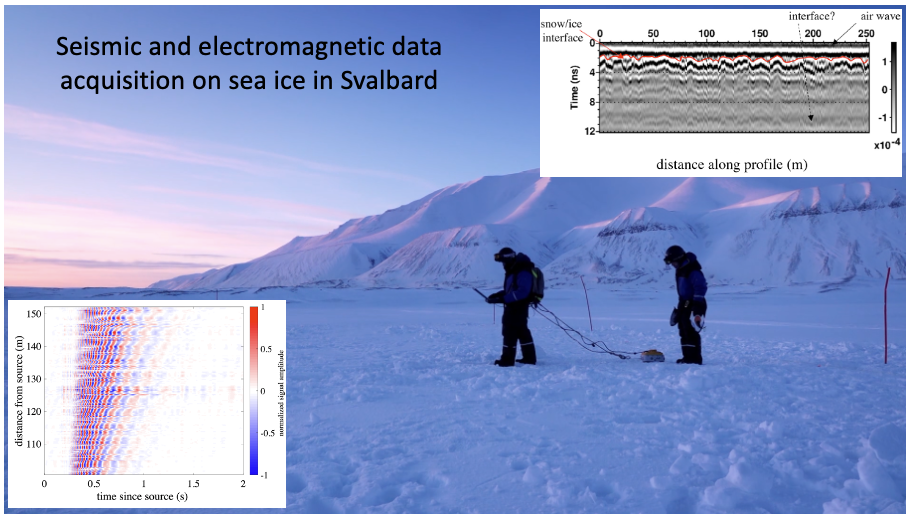
The "Geophysical Imaging of the Earth" program is for students interested in the understanding and evolution of the Earth's internal processes and structures, at different scales. It addresses several aspects of geophysics: environmental geophysics (changes in the cryosphere related to global warming, geothermal energy, hydrology, natural hazards...), fundamental geophysics (study of fault zones and earthquakes, volcano studies and monitoring, deep Earth dynamics...) and multi-scale and multi-physics imaging/monitoring.
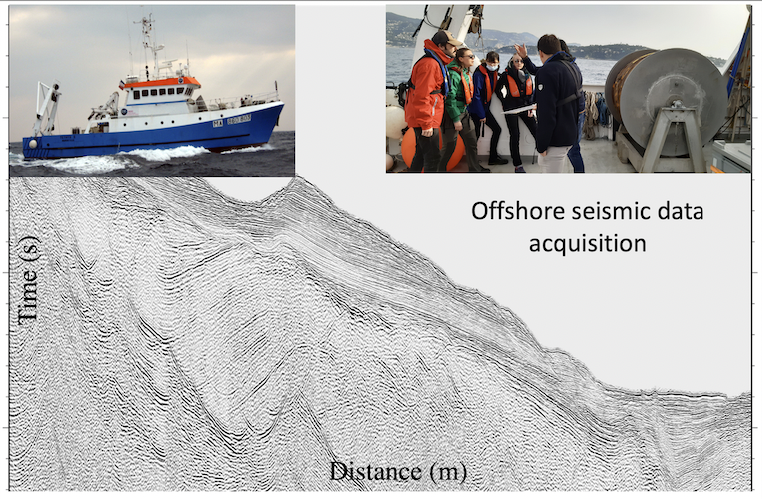
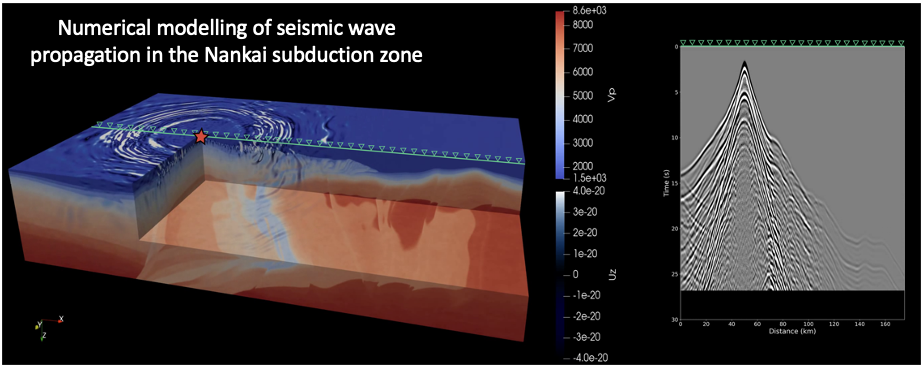
These structures are mainly understood by their seismic, magnetic, electrical or gravimetric signatures, and their deformation movements. In the era of Big Data, the teaching is therefore resolutely oriented towards i) the acquisition of data during field and/or laboratory experiments, ii) the use of continuous observatory-type data, iii) their analysis via signal processing methods, as well as iv) their modelling and inversion by classical and advanced approaches (machine learning, use of numerical models...)
The students trained in the Geophysical Imaging of the Earth program will be able to demonstrate their skills as geophysical engineers and apply for jobs offered by design offices, public research institutes or large industrial groups concerned with the imaging, characterization and temporal monitoring of the physical properties of underground environments and their natural reservoirs in various environments. The main applications of this work are in the fields of seismology, civil engineering, natural hazard assessment, natural resource exploration and production including geothermal and hydrology, and the storage of fluids or solid wastes underground. There are many opportunities for internships in Earth science research laboratories (ISTerre in Grenoble), but also in operational research offices (BRGM) or in companies and design offices. The course also opens the way to a PhD.
Formation internationale
Formation tournée vers l’international
Dimension internationale
Study abroad as an exchange student
As part of this track, you have the opportunity to study for a semester or a year at a UGA partner University abroad.
The International Relations Officers of your faculty will be able to provide you with more information.
More information on : https://international.univ-grenoble-alpes.fr/partir-a-l-international/partir-etudier-a-l-etranger-dans-le-cadre-d-un-programme-d-echanges/
Programme
Sélectionnez un programme
Master 1re année
UE Geophysical observation of the Earth
6 créditsUE Physique et Chimie de la Terre / Physics and Chemistry of the Earth
6 créditsUE Signal Processing
6 créditsUE Programmation et environnements informatiques
3 créditsUE Waves Physics
3 créditsAu choix : 2 parmi 3
UE Géodynamique Interne / Deep Earth Geodynamics
6 créditsUE Géophysique d'exploration / Exploration geophysics
6 créditsUE Data sciences & Inverse problems
3 créditsUE Dynamique et risque volcanique / Volcanic dynamics and hazards
3 créditsUE Instrumentation for geophysics
3 créditsUE Introduction to Machine learning in Earth Sciences
3 créditsUE Scientific computing
3 créditsAu choix : 1 parmi 2
UE Marine Geophysics
3 créditsUE Sismicité induite / Induced seismicity
3 crédits
Master 2e année
UE Frontiers in seismic imaging (Noise + FWI)
6 créditsUE Quantitative seismology
6 créditsUE Advanced signal Processing
3 créditsUE Computing and data analysis Project
3 créditsAu choix : 2 à 4 parmi 5
UE Active Faults
6 créditsUE Doctoral School - InternalEarth@les Houches
6 créditsUE Near-Surface Geophysics
6 créditsUE Advanced Machine Learning in Earth Sciences
3 créditsUE Numerical Modelling
3 crédits
UE Stage court
6 créditsUE Stage long
24 crédits
Admission
Conditions d'admission
La 1re année de master est ouverte aux personnes qui ont obtenu un diplôme national conférant le grade de licence dans un domaine compatible avec celui du master ou via une validation d’études ou d’acquis.
L’entrée en 2e année de master peut être sélective. Elle est ouverte sur dossier aux candidats titulaires d'une première année de master dans le domaine.
Public formation continue : Vous relevez de la formation continue :
- si vous reprenez vos études après 2 ans d'interruption d'études
- ou si vous suiviez une formation sous le régime formation continue l’une des 2 années précédentes
- ou si vous êtes salarié, demandeur d'emploi, travailleur indépendant
Si vous n'avez pas le diplôme requis pour intégrer la formation, vous pouvez entreprendre une démarche de validation des acquis personnels et professionnels (VAPP)
Pour plus d'informations, consultez la page web de la Direction de la formation continue et de l’apprentissage
Vous pouvez également Consulter les tarifs s'appliquant aux publics de la formation continue.
Candidature
Vous souhaitez candidater et vous inscrire à cette formation ?
Laissez-vous guider simplement en suivant ce lien
You want to apply and sign up for a master? Please be aware that the procedure differs depending on the diploma you want to take, the diploma you have already obtained and, for foreign students, your place of residence.Let us be your guide – simply follow this link
Public cible
- Étudiants en formation initiale ayant obtenu une licence en Physique, Mécanique ou Sciences de la terre
- Étudiants étrangers souhaitant poursuivre leurs études dans le domaine de la géophysique en France
- Étudiants en formation continue souhaitant se perfectionner dans le domaine de la géophysique
Droits de scolarité
Et après
Poursuite d'études
Les étudiants diplômés du master Sciences de la terre et des planètes, environnement parcours Géophysique pourront poursuivre leurs études par une thèse de doctorat, ou compléter leur formation par une spécialisation en informatique ou dans les méthodes de gestion d’entreprises.
Passerelles et réorientation
Une réorientation vers le parcours Géorisques est possible jusqu'à la fin de la 1re année de master. En fonction du choix des UE en semestres 7 et 8, des réorientations vers les parcours Géodynamique ou Géoressources sont également possibles.
Enfin, une passerelle Géosciences existe localement dans le master Physique grâce à deux modules Imagerie et ondes dans les milieux naturels (3 ECTS) et Fluides géophysiques et/ou instabilités (3 ECTS) de ce master, Visa Matière complexe, matière vivante, permettant aux étudiants ayant suivi ces modules d'intégrer le parcours Géophysique en 2e année de master.
Insertion professionnelle statistiques
Retrouvez toutes les informations concernant le taux de réussite au diplôme et le devenir de nos diplômés.
Il est également possible de consulter nos documents-ressources Des études à l’emploi classes par domaines de formation.
Secteur(s) d'activité(s)
Les étudiant(e)s ne souhaitant pas poursuivre leur cursus par une thèse de doctorat auront vocation à trouver un emploi d’ingénieur(e) géophysicien(ne) opérant dans des bureaux d’études, des organismes de recherche publics ou de grands groupes industriels concernés par l’imagerie, la caractérisation et le suivi temporel des propriétés physiques des milieux souterrains et de leurs réservoirs naturels. Une partie des enseignements sera dispensée en langue anglaise.